
Thermodynamic and Kinetic Control
of Organic reactions
The following scheme illustrates the process of kinetic and thermodynamic controls
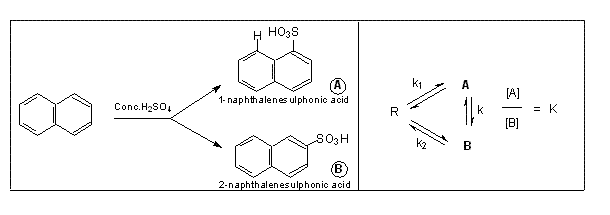
Conclusions:
In reactions that proceed through different pathways leading to different products, if the major product is that derived from the pathway of lower energy of activation then the reaction is under kinetically control (even if the other product is more stable).
- [A] / [B] = k1 / k2 that is the product proportion is the ratio of the rate constants of the two pathways.
- If the major product is the more sable product then the reaction is under thermodynamic control.
- [A] / [B] = K where K is the equilibrium constant (the equilibrium is between the two isomeric products).
- For this to be possible the reaction conditions should be suitable for establishing equilibrium between the reactants and the kinetically controlled products.
- The major product is the one, which is associated with lower free energy (ΔG0).
- In kinetic controlled reactions the major product is the one that has a lower activation energy barrier (ΔG‡) for the reaction pathway.
Comparison
Under
kinetic control
Under
Thermodynamic control
The product proportion reflects the relative rates of formation of
the processes.
The product proportion reflects the relative free energies of the products.(that is the thermodynamic stability)
The reaction can be under kinetic control before
equilibrium conditions are established.
equilibrium conditions are established.
The reaction is under thermodynamic control when equilibrium conditions
are established.
Copyrights: 2005 www.chemvista.org All Rights Reserved
The image in the header section is from Wikipedia